 Posted by
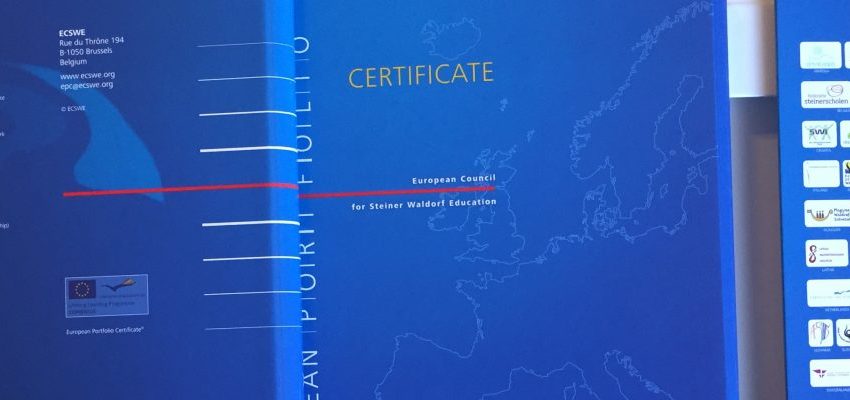
 The European Portfolio Certificate (EPC) [1] Folder is a documentation of formal, non-formal and informal learning [2] with respect to knowledge, skills, attitudes and competences [3]. It is divided into three parts and contains:
1 | School leaving certificates from the school and from awarding bodies (pocketed in the left side),
2 | Learning outcome documents including portfolio documents and portfolio awards and certificates as chosen by the student (collected in the centre) and
3 | An overview of educational principles on which the school is based (pocketed in the right side).
The EPC Folder is issued as a school leaving certificate portfolio for students who have completed at least one evaluated portfolio or portfolio certificate and who receive an accredited diploma at EQF [4] level 2 or higher. Without such a diploma, a folder that meets the EPC Standards may still be issued to students if they are at least 15 years old. In this case, it is strongly recommended that the issuing school include competence profile career advice for the student.
Portfolio based assessment indicates competences, motivates learners by showing individual strengths and stimulates self-reflection and entrepreneurship [5], thereby strengthening the individual dimension of lifelong learning.
The European Portfolio Certificate project aims to innovate education by starting or intensifying portfolio work, allowing students leaving secondary school to document their work in a portfolio folder. Students in schools participating in the project are encouraged to pursue learning goals in line with the development of their individual interests, whether by taking up and working on a subject introduced by the teacher, or by selecting and working on a theme under their own initiative. The teacher seeks to assist students in their learning process through a dialogue in which previously formed knowledge and newly-forming knowledge interact to yield a rich and creative outcome. Working with the European Portfolio Certificate can help to re-kindle interest in learning based on the school’s curriculum by enabling a more individualised learning approach where the student’s interest is fully engaged.
Undertaking the work of creating a portfolio goes hand in hand with self-reflection and evaluation. Once completed, a portfolio can then be summarised by a Portfolio Certificate that serves as a convenient statement of important aspects of the learner’s development. The Certificate, together with the portfolio work itself, reveals the capacity of the learner to review, reflect on and evaluate his/her own learning. In addition, portfolio presentations provide social acknowledgement within and beyond the school community and help to build personal competence and self-assurance. Many students will wish to use their European Portfolio Certificate Folder to collect and show evidence of their learning to be used in their continuing journey into other formal education institutions or employment.
The central part of the folder gives room for students to collect portfolios and portfolio certificates of their choice. With space for formal certificates of education in the left flap and an overview of the principles of the educational route taken in the right flap, the EPC Folder can be presented to potential employers or to education institutions which are interested in knowing more about the particular competences our students have brought to light in their lives.
Portfolio work is a practical methodology for engaging the motivation, thinking skills and creative action of young people. The EPC-project is based on this insight. In the hands of sincere educators, it allows for the sparking of the life of the student in a way that can become an unquenchable fire in the soul – a fire that strengthens the student from within, and empowers him/her to engage as a positive individual in a world of growing complexity. Whether you be teacher, student, parent or school administrator, we encourage you to prompt your school to join the worldwide effort towards uplifting educational change.
[1] “European Portfolio Certificate” is a registered trademark. Organisations that wish to use the folder must obtain a licence from the EPC Group.
[2] Formal Learning: Learning that occurs in an organised and structured environment (in an education or training institution or on-the-job) and is explicitly designated as learning (in terms of objectives, time or resources) Formal learning is intentional from the learner’s point of view. It typically leads to validation and certification.
Learning which is embedded in planned activities not explicitly designated as learning (in terms of learning objectives, learning time or learning support). Non-formal learning is intentional from the learner’s point of view. Comments:
- non-formal learning outcomes may be validated and lead to certification;
- non-formal learning is sometimes described as semi-structured learning.
Informal Learning: Learning resulting from daily activities related to work, family or leisure. It is not organised or structured in terms of objectives, time or learning support. Informal learning is in most cases unintentional from the learner’s perspective. Comments: - informal learning outcomes do not usually lead to certification but may be validated and certified in the framework of recognition of prior learning schemes;
- informal learning is also referred to as experiential or incidental/random learning.
The three characterisations above are taken from the CEDEFOP publication “Validation of non-formal and informal learning in Europe. A snapshot 2007”, p. 45f, available at www.cedefop.europa.eu/EN/publications/12954.aspx.
[3] ‘Skills’ are described as cognitive (involving the use of logical, intuitive and creative thinking) or practical (involving manual dexterity and the use of methods, materials, tools and instruments). ‘Competence’ means the proven ability to use knowledge, skills and personal, social and/or methodological abilities. Competence is described in terms of responsibility and autonomy (cf. the annex to the “Recommendation of the European Parliament and of the Council of 23 April 2008 on the establishment of the European Qualifications Framework for lifelong learning”
http://eur-lex.europa.eu/LexUriServ/LexUriServ.do?uri=OJ:C:2008:111:0001:0007:EN:PDF).
[4] “EQF” stands for the “European Qualification Framework”. The EQF was adopted by the European Parliament and Council on 23 April 2008. The EQF encourages countries to relate their qualifications systems or frameworks to the EQF by 2010 and to ensure that all new qualifications issued from 2012 carry a reference to the appropriate EQF level.
[5] Entrepreneurship has an active and a passive component: it comprises both the propensity to induce changes oneself and the ability to welcome, support and adapt to innovation brought about by external factors. Entrepreneurship involves taking responsibility for one’s actions, positive or negative, developing a strategic vision, setting objectives and meeting them, and being motivated to succeed. (cf. “Key Competences For Lifelong Learning. A European Reference Framework, November 2004).